ChatGPT Credit Score: What It Is and How to Check It
OpenAI added a credit score feature to ChatGPT Finances, letting US Plus and Pro users connect Experian and check VantageScore 3.0 monthly.
OpenAI has added a credit score feature to ChatGPT: US-based Plus and Pro subscribers can now connect an Experian credit report and see their VantageScore 3.0 credit score directly inside the chat app, with the score and report refreshing monthly. The feature, called "Credit scores in Finances," rolled out on September 21, 2026 as part of ChatGPT's existing Finances tool, and checking your score this way counts as a soft inquiry, so it does not lower your credit score.
- Feature name: Credit scores in Finances (part of Finances in ChatGPT)
- What it does: Shows your Experian credit report and VantageScore 3.0 score, with factor-level detail and monitoring alerts
- Who gets it: ChatGPT Plus and Pro subscribers in the United States, on web, iOS, and Android
- Rollout date: September 21, 2026 (rolling out gradually; some eligible users may not see it immediately)
- Update frequency: Score and report refresh monthly
- Checking your score: A soft inquiry — it does not affect your credit score
- Data handling: Disconnecting stops Experian from sharing data, and OpenAI deletes the underlying credit report data within 30 days
What the ChatGPT Credit Score Feature Actually Does
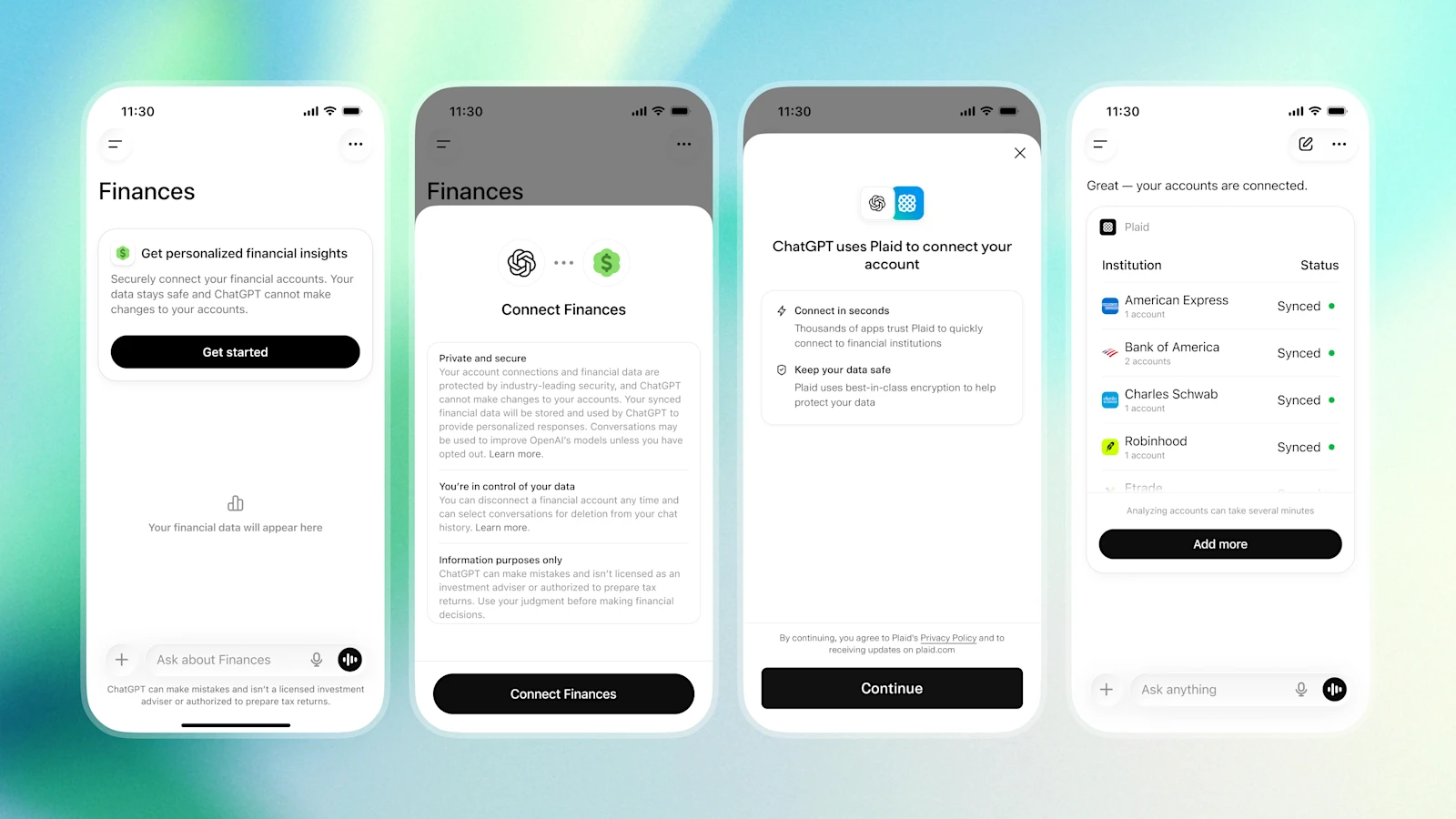
The new capability lives inside Finances in ChatGPT, the section OpenAI first introduced earlier in 2026 for connecting bank accounts through Plaid. Credit scores are a separate addition to that tool. Once connected, users can view their Experian credit report and VantageScore 3.0 score on the Finances page, or simply ask ChatGPT questions in a normal conversation, such as "which factors are affecting my credit score" or "what should I understand about my credit before applying for a mortgage."
According to OpenAI's own release notes, the feature lets people "securely connect your Experian credit report and VantageScore 3.0 credit score to get personalized insights into what's affecting your score and how it relates to your finances and goals." That framing matters: this is not just a number on a dashboard. ChatGPT can also explain the individual factors behind the score, like payment history, credit utilization, account age, and recent inquiries, and tie that explanation back to a user's broader financial goals if they have also connected a bank account or shared context with the assistant.
The credit-score feature is deliberately kept separate from the bank-account side of Finances. You do not need to connect any bank account through Plaid to use it, and connecting your credit report does not give ChatGPT access to your bank balances or transactions.
How the Experian and VantageScore 3.0 Connection Works
Experian is one of the three major US consumer credit bureaus, alongside TransUnion and Equifax. With a user's authorization, Experian shares an ongoing feed of that person's credit report, credit score, and monitoring alerts with ChatGPT. OpenAI's help documentation is explicit that this is a data-sharing relationship rather than ChatGPT independently pulling or calculating anything: Experian, described as OpenAI's "service provider" for this feature, collects identity-verification information directly through its own form, and OpenAI only receives the connection status and whatever credit data the user has authorized Experian to share.
The score itself is VantageScore 3.0, a model jointly developed by Experian, TransUnion, and Equifax that scores consumers on the familiar 300-to-850 scale. A higher score signals a lower credit risk to lenders; a lower score signals higher risk. VantageScore is a separate model from FICO, which many lenders also use, and OpenAI's own disclosure text is careful to note that VantageScore 3.0 "is used by some but not all lenders."
Once a user connects Experian, ChatGPT can display reported accounts, balances, credit limits, utilization, payment history, and inquiries, and let the user tap into any individual factor for more detail. Available detail depends on what Experian shares for that account, so not every user will see identical breakdowns.
Who Can Use It: Plans, Countries, and Platforms
Per OpenAI's release notes, the credit-score feature is "rolling out in Finances to Plus and Pro users in the U.S. on web, iOS, and Android," with the caveat that "some eligible users may not see it right away" as the rollout continues. That mirrors how OpenAI staged the original Finances launch earlier in the year, which also began with a smaller group before expanding. There is no indication yet of availability for ChatGPT Free or Go users, for Business and Enterprise workspaces, or for users outside the United States, since Experian's consumer credit-reporting relationship in this integration is US-specific.
For anyone comparing what each ChatGPT tier unlocks, Pandromeda's rundown of ChatGPT, Claude, and Gemini plans and pricing is a useful reference for where Plus and Pro sit relative to the free tier and to competing assistants, since this credit feature is currently gated to the two paid personal plans.
How to Connect Your Credit Report in ChatGPT
OpenAI's help article lays out a straightforward process, separate from the bank-linking flow:
- Ask ChatGPT to connect your credit score, or select the option to connect it from the Finances home page.
- Complete Experian's own identity-verification form. OpenAI's documentation stresses that personal information and verification codes should be entered into Experian's form, not typed into the ChatGPT conversation itself.
- Return to ChatGPT to view your score and ask questions about your credit.
After that first connection, the score and report update monthly, and users may only see a single data point the first time they connect, with history building as additional monthly updates arrive. Credit monitoring can also alert users to changes such as a new inquiry, a new account, or an address change on file, and those alerts can be turned off in notification settings without disconnecting the underlying Experian connection.
What ChatGPT Can and Cannot Do With Your Credit Data
OpenAI draws a clear boundary between using ChatGPT to understand your credit and giving it any ability to act on your behalf. The company's help documentation lists specific things the assistant is barred from doing, credit-related or otherwise.
| ChatGPT can | ChatGPT cannot |
|---|---|
| Show your Experian credit report and VantageScore 3.0 score | Change information on your Experian credit report |
| Explain which factors are affecting your score (utilization, payment history, inquiries, account age) | File a dispute or freeze your credit on your behalf |
| Send monitoring alerts for new accounts, inquiries, or address changes | Move money, pay bills, or make trades |
| Answer questions about how credit relates to a mortgage, card, or loan decision | Act as your financial, legal, tax, or investment adviser |
| Update the score and report on a monthly cadence | Show live account activity between Experian's report dates |
If something in the report looks wrong, ChatGPT is not the tool to fix it. OpenAI's guidance directs users with an unfamiliar account, incorrect information, or suspected identity theft to contact Experian directly, since ChatGPT cannot dispute or edit a credit file.
Does Checking Your Score in ChatGPT Hurt It? Soft Inquiries Explained
No. OpenAI states plainly that "checking your score through this connection is a soft inquiry and does not affect your credit score." A soft inquiry is a background check that a consumer bureau or lender can run without it registering as an application for new credit, which is what triggers a hard inquiry and a small, temporary score dip. Because Experian is simply relaying a user's own existing report and score to ChatGPT at their request, it functions the same way as checking your score through a bank app or Experian's own site: repeated checks will not ding your VantageScore 3.0.
That said, the number shown in ChatGPT is a snapshot from Experian's most recent report, not a live feed. OpenAI's documentation notes that "credit widgets reflect your latest Experian report, not live account activity; a recent payment may not appear until your lender reports it and your report updates." The same is true of balances: a credit-report balance can lag behind what shows up in a bank account, because it reflects whatever a lender most recently reported to Experian rather than a real-time figure.
ChatGPT vs Traditional Ways to Check Your Credit Score
ChatGPT's version of a credit check sits alongside, rather than replaces, the ways people already monitor their credit. The table below lines up what's distinct about getting your score through ChatGPT compared with going directly to a bureau, a bank, or a dedicated monitoring app.
| Method | Score model shown | Update frequency | Notable feature |
|---|---|---|---|
| ChatGPT (Finances) | VantageScore 3.0 via Experian | Monthly | Conversational explanations of what's driving score changes |
| Experian's own site or app | FICO and/or VantageScore, depending on product | Varies by product, often monthly | Direct access to dispute tools and full report detail |
| A bank or card issuer's free score tool | Usually FICO or a VantageScore model, set by the issuer | Typically monthly | Tied to an existing account you already use |
| A mortgage or auto lender's pull | Often a FICO model specific to that lending industry | At time of application | The score that actually determines loan terms, and often a hard inquiry |
The practical takeaway is one OpenAI's own disclosure spells out: "your lender may not use VantageScore 3.0, so don't be surprised if your lender gives you a score that's different from your VantageScore." A VantageScore 3.0 shown in ChatGPT is a legitimate, widely used credit score, but it is not guaranteed to match the specific score model a mortgage underwriter or auto lender pulls at the moment of a real credit decision.
Privacy, Data Retention, and How to Disconnect
Because a credit report is sensitive financial data, OpenAI's documentation spends considerable space on user control. Bank accounts (via Plaid) and credit reports (via Experian) are treated as entirely separate connections, and a user can disconnect either one independently, from Settings, without affecting the other.
On disconnecting the Experian link specifically, OpenAI states: "Experian will stop sharing credit scores and reports with ChatGPT, and OpenAI will also delete the underlying Experian credit report data from OpenAI systems within 30 days. Disconnecting does not remove information from past conversations or financial memories, which you can delete separately." In other words, the live data pipeline shuts off immediately and the stored copy is purged within 30 days, but anything ChatGPT already said about your credit in a past chat, or saved as a "financial memory," persists until you delete those conversations or memories yourself. Disconnecting Experian from ChatGPT also has no effect on your actual Experian credit file or on any other Experian products you use separately.
Two other privacy details are worth knowing. First, temporary chats in ChatGPT do not access connected financial or credit data and are not used to create or update financial memories. Second, whether Finances conversations are used for model training follows the same data-control setting a user has already chosen elsewhere in ChatGPT, adjustable at any time in Settings.
Why the Number in ChatGPT Might Differ From Other Scores
It's common to see a different number from three different services, and OpenAI's help center includes a lengthy disclosure explaining why. Credit files themselves can differ between Experian, TransUnion, and Equifax, because some lenders only report account activity to one or two bureaus. Even using the same underlying file, different scoring models weigh factors differently, so a VantageScore and a FICO score calculated from the same Experian data can land at different points. Report dates matter too: since a credit file can change day to day, a score pulled today may not match one pulled last week even from the same bureau and model.
OpenAI's disclosure adds a more consequential warning: "for some consumers, however, the risk assessment of VantageScore 3.0 could vary, sometimes substantially, from a lender's score. If the lender's score is lower than your VantageScore 3.0, it is possible that this difference can lead to higher interest rates and sometimes credit denial." That's a reason to treat the ChatGPT number as a useful, monitored reference point rather than the exact figure a lender will see when it's time to apply for credit.
What's Next for Credit Scores in ChatGPT
OpenAI has already signaled the direction it wants Finances to move in. In the blog post introducing the broader Finances tool, the company said it is working with partners like Intuit so that a user could go "from getting a credit card recommendation to understanding their approval odds and submitting an application... all inside ChatGPT." Credit scores plugged into Finances are a step toward that kind of loop, where the assistant does not just explain a number but helps someone act on it, budget around it, or plan for it, while the underlying decision (approving a card, setting a mortgage rate) still stays with the outside lender.
What to watch for going forward: whether the credit-score feature expands beyond Plus and Pro to Free and Go users, whether it moves beyond the US alongside markets where Experian and VantageScore already operate, and whether OpenAI adds features that go further than explanation, such as tracking score-improvement plans over time. It's also the kind of capability that fits a broader pattern of assistants doing more autonomous, multi-step reasoning over a user's real-world data, the same shift Pandromeda has covered in its explainer on what an AI agent is and how it actually works. For now, the feature remains what OpenAI's own documentation describes: a way to view and understand an existing Experian credit report and VantageScore 3.0 score inside ChatGPT, updated monthly, without the ability to change anything on the report itself.
Frequently asked questions
What is the ChatGPT credit score feature?
It is a new part of Finances in ChatGPT, called Credit scores in Finances, that lets US Plus and Pro users connect their Experian credit report and see their VantageScore 3.0 score, updated monthly, according to OpenAI's help center.
Does checking my credit score in ChatGPT hurt my score?
No. OpenAI states that checking your score through the Experian connection is a soft inquiry, which does not affect your credit score.
Is the ChatGPT credit score feature available outside the US?
No. As of its September 2026 rollout, it is limited to ChatGPT Plus and Pro subscribers in the United States on web, iOS, and Android, with some eligible users seeing it later than others as the rollout continues.
What happens to my credit data if I disconnect Experian from ChatGPT?
Experian stops sharing your credit score and report with ChatGPT, and OpenAI deletes the underlying credit report data from its systems within 30 days, according to OpenAI's help documentation. Past conversations and financial memories are not automatically deleted.
Why might my ChatGPT credit score differ from the score my lender shows?
ChatGPT displays VantageScore 3.0, and OpenAI notes that lenders may use a different scoring model, such as FICO, or pull from a different bureau or report date, which can produce a different number.
Do I need to connect a bank account to see my credit score in ChatGPT?
No. Bank accounts connect through Plaid and credit reports connect through Experian as separate connections, so you can use the credit-score feature without linking a bank account.
Sources
- OpenAI Help Center – Finances in ChatGPThelp.openai.com
- OpenAI – ChatGPT Release Noteshelp.openai.com
- OpenAI – A new personal finance experience in ChatGPTopenai.com
- Experian – What Is a VantageScore Credit Score?experian.com
- Wikipedia – VantageScoreen.wikipedia.org
Theo Park runs the AI desk at Pandromeda. He follows model launches from the frontier labs and the open-weight community, tracks the assistants and developer tools built on them, and explains what each release changes on pricing, capability and safety. His reporting leans on primary sources: model cards, technical reports, API documentation and the companies' own announcements.