Runway Gen-4.5 vs Sora 2: Which AI Video Tool Wins in 2026?
A head-to-head look at Runway's Gen-4.5 video model and OpenAI's now-discontinued Sora 2, covering pricing, resolution, clip length, and what to use instead.
Runway Gen-4.5 wins this matchup by default, because it's the only one of the two still running. OpenAI pulled the Sora 2 consumer app on April 26, 2026, and shut down the Sora developer API entirely on September 24, 2026, with no replacement API announced. So "Runway Gen-4.5 vs Sora 2" is really a question about how Runway's current flagship video model stacks up against a historical one you can no longer sign up for, pay for, or call through an API. Below is the full pricing, resolution, clip-length, and feature comparison, plus what to use instead of Sora 2 today.
Quick facts
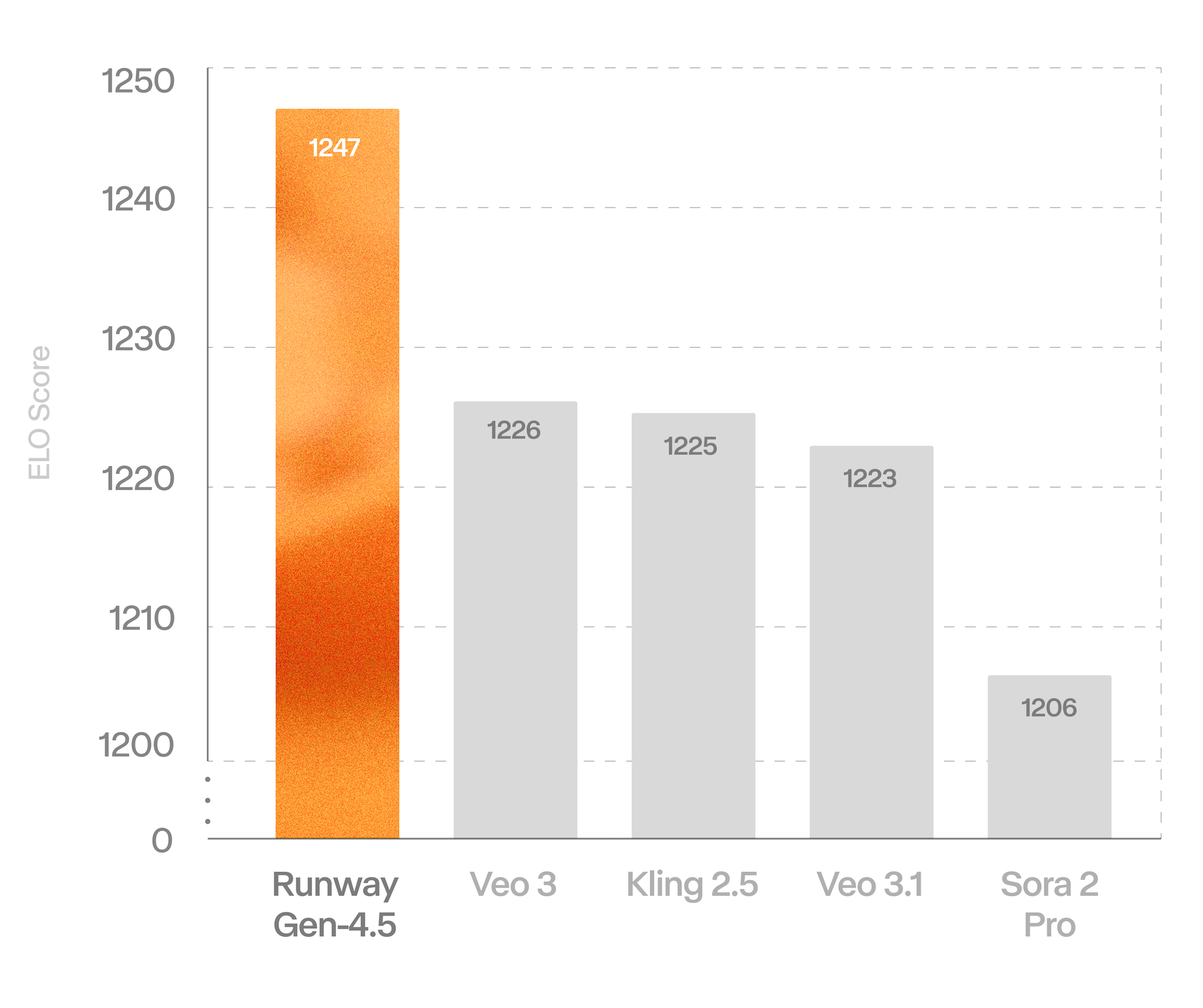
- Runway Gen-4.5 launched December 1, 2025 and tops the Artificial Analysis Text-to-Video leaderboard with an Elo score of 1,247.
- Gen-4.5 is available on Runway's Standard plan and up, starting at $12/month (billed annually) for 625 credits, or $0.12 per second through Runway's API.
- Sora 2's consumer app shut down April 26, 2026; its developer API was discontinued September 24, 2026.
- Before shutdown, the Sora API generated up to 1080p video (via sora-2-pro) in 16- or 20-second clips, extendable to 120 seconds total.
Is Sora 2 still available in 2026?
No. OpenAI announced in March 2026 that it would discontinue Sora across both the mobile app and the API. The consumer app and sora.com stopped working on April 26, 2026, and the developer API followed on September 24, 2026. OpenAI's own developer documentation still carries the notice: the Sora 2 models and Videos API "were shut down on September 24, 2026," and the page states plainly that "no one-to-one replacement API is available." OpenAI hasn't published a detailed explanation, though reporting around the shutdown pointed to compute costs and a shift in the Sora research team toward world-simulation work for robotics rather than running a consumer video app and API. We covered the shutdown in more depth in our explainer on Sora 2's price, access, and why it was shut down.
That matters for anyone typing "Runway Gen-4.5 vs Sora 2" into Google expecting a live, sign-up-today comparison: one side of this fight has left the building. What follows treats Sora 2 as a historical model — useful to understand because its specs still shape how people judge newer tools, including Gen-4.5.
What is Runway Gen-4.5?
Gen-4.5 is Runway's flagship text-to-video and image-to-video model, announced on December 1, 2025 as a direct successor to Gen-4. Runway's own Gen-4.5 announcement frames it around four things: stronger prompt adherence (including more believable physics, object weight, and liquid dynamics), better handling of complex, multi-element and continuous no-cut scenes, more expressive characters with nuanced emotion and gesture, and a broader stylistic range that stays visually consistent across a generation. Runway says the model keeps the speed and efficiency of Gen-4 despite the quality jump, and that existing control modes — Image to Video, Keyframes, Video to Video — are being brought over to Gen-4.5 as well.
Runway is upfront about the model's limits, too. Its research page lists three known failure modes: causal-reasoning errors (an effect appearing to precede its cause, like a door opening before the handle turns), object-permanence slips (objects vanishing or reappearing across frames), and a "success bias," where actions in a generated clip succeed more often than they realistically would. None of that is unique to Runway — every current video model has some version of these artifacts — but it's worth knowing going in.
On benchmarks, Runway's launch post reports Gen-4.5 ranked #1 on the Artificial Analysis Text-to-Video leaderboard as of November 30, 2025, with an Elo score of 1,247 from blind, pairwise human preference votes — ahead of Google's Veo 3 (1,226), Kling 2.5 (1,225), Veo 3.1 (1,223), and OpenAI's Sora 2 Pro (1,206). That's Runway's own framing of a third-party leaderboard, so treat it as a snapshot rather than a permanent ranking; these boards shift every time a new model ships.
What was Sora 2?
Sora 2 was OpenAI's second-generation video and audio generation model, unveiled on September 30, 2025 alongside a standalone, TikTok-style iOS app (an Android app followed roughly two months later), first rolling out to invited users in the US and Canada and tied to a ChatGPT account. Its headline upgrades over the original Sora were synchronized audio — ambient sound, dialogue, and sound effects generated alongside the video — more accurate physics, and a social feed built around remixing other users' clips. Its most talked-about feature was "cameos" (also called "characters"): with consent, a person's likeness and voice could be inserted into generated videos, with the ability to revoke access and delete clips afterward. Outputs carried a visible watermark and C2PA provenance metadata, per Wikipedia's entry on the model.
On the developer side, OpenAI's video generation guide — still live as a historical reference after the shutdown — describes two Sora API models: sora-2 for faster iteration and sora-2-pro for higher-quality, production-grade output. The API supported text-to-video, image references (using a still as the first frame), reusable non-human "character" uploads, video extensions that preserved motion and scene continuity, targeted edits to existing clips, a batch API for offline rendering, and webhook or polling-based job notifications. Standard sora-2 topped out at 720p and 480p renders; 1080p exports (1920x1080 or 1080x1920) required sora-2-pro. Both models supported 16- and 20-second generations, and a finished video could be extended up to six times, each extension adding up to 20 seconds, for a maximum stitched length of 120 seconds.
Pricing compared
Comparing "current price" is awkward when one product no longer has one. Runway's pricing below is live and verified on runway.com/pricing and its developer platform; the Sora figures reflect what OpenAI's documentation described while the product was active, since OpenAI has not republished a pricing page for a discontinued API.
| Runway Gen-4.5 | Sora 2 (historical) | |
|---|---|---|
| Status | Active, current flagship model | Discontinued (app: Apr 26, 2026; API: Sep 24, 2026) |
| Consumer entry price | Free plan exists, but Gen-4.5 requires Standard ($12/mo billed annually, 625 credits/mo) | Free to use inside the Sora app, subject to compute-based generation limits |
| Higher tier | Pro: $28/mo (2,250 credits) · Max: $76/mo (9,500 credits) | Sora 2 Pro required a ChatGPT Pro subscription |
| Generation cost | 12 credits per second of video (consumer); $0.12/sec via API | Billed per second via API; OpenAI's own pricing page is no longer published |
| Max resolution | 720p | 720p/480p standard; 1080p with sora-2-pro |
| Max clip length | Up to 10 seconds per generation (API) | 16–20 seconds per generation, extendable to 120 seconds total |
| Inputs | Text, image | Text, image reference, reusable character uploads |
A note on the credit math: Runway's FAQ states Gen-4.5 costs 12 credits per generated second, so a 5-second clip runs 60 credits. On the $12/month Standard plan's 625 monthly credits, that's roughly 52 seconds of Gen-4.5 output a month before you need to buy more or upgrade. The Max plan's 9,500 credits stretch to a little over 13 minutes of generated footage.
Resolution and clip length
Neither model is built for long-form output in a single pass. Runway's developer platform caps Gen-4.5 at 720p and 10 seconds per generation; Runway hasn't published a higher native resolution tier for Gen-4.5 at the time of writing. Sora 2, while it existed, had the edge on both fronts for anyone paying for sora-2-pro: 1080p output, 16- to 20-second base clips, and extensions that could chain up to 120 seconds of continuous footage. Standard sora-2 was closer to Gen-4.5's ceiling, limited to 720p/480p.
In practice, both models were (and Gen-4.5 still is) best treated as shot generators rather than full-scene renderers — you generate short clips and assemble them in an editor, rather than asking for a finished one-minute sequence in one call.
Feature comparison
The two models were built for different jobs. Gen-4.5 is aimed at creative and production work inside Runway's broader toolset — control modes like Keyframes and Video-to-Video, an API for pipeline integration, and partner/enterprise access. Sora 2 was built around a consumer social product first and a developer API second: its standout features (cameos, a remix-based social feed, synchronized dialogue and ambient audio) were about putting yourself and your friends into shareable clips, not professional post-production.
- Prompt adherence and physics: Runway highlights this as Gen-4.5's biggest jump over Gen-4, including more realistic liquid, weight, and momentum behavior.
- Audio: Sora 2 generated synchronized audio (dialogue, ambient sound, effects) natively. Runway's Gen-4.5 materials don't make audio a headline feature.
- Identity/characters: Sora 2's cameo system let people insert a consented likeness into clips. Runway's character-consistency tools instead work from reference images rather than a verified personal likeness system.
- Editing continuity: Sora 2's API supported direct edits and extensions to existing generated videos. Runway's control modes (Keyframes, Video-to-Video) solve a similar continuity problem from a different angle.
- Integration: Gen-4.5 is reachable through Runway's own editor, API, and partner integrations; it's a working, billable product today. Sora 2's API returns errors — there's nothing to integrate against anymore.
Benchmark performance: who actually looked better?
The one head-to-head data point we have comes from Runway's own launch materials, which cite the Artificial Analysis Text-to-Video leaderboard. As of the November 30, 2025 snapshot Runway published, Gen-4.5 led with an Elo of 1,247, ahead of Veo 3 (1,226), Kling 2.5 (1,225), Veo 3.1 (1,223), and Sora 2 Pro (1,206) in blind pairwise human-preference voting. That's a meaningful result, but two caveats apply: it's Runway citing a leaderboard about its own model on launch day, and Artificial Analysis rankings move constantly as new models ship — this snapshot predates several Veo and Kling updates that have followed since. Early hands-on coverage after the launch also noted Gen-4.5 still struggles with the same causality and object-permanence issues Runway itself disclosed, so "benchmark leader" doesn't mean "flawless."
Which one should you actually use in 2026?
Since Sora 2 isn't an option anymore, this is less "which do I pick" and more "what do I use instead." A few practical notes:
- If you want Runway's current best model: You need at least the Standard plan ($12/month annually, $15 month-to-month) to unlock Gen-4.5 — the Free tier's one-time 125 credits don't cover it.
- If you were a Sora 2 user: There's no OpenAI replacement to migrate to; the Sora research team has shifted toward other work, per OpenAI's developer notice. Your realistic options are Runway Gen-4.5, Google's Veo 3.1, or another current text-to-video model.
- If audio-in-the-clip mattered to you: That was one of Sora 2's defining features and isn't something Runway markets as a core Gen-4.5 capability, so budget for a separate audio/voice step in your workflow.
- If you need longer clips: Gen-4.5's 10-second cap via the API is shorter than Sora 2's old 16–20 second base clips. Stitching several Gen-4.5 generations together in an editor is the current workaround.
For a broader look at what replaced Sora 2 in head-to-head terms, see our comparisons of Sora 2 vs Veo 3.1, written while Sora 2 was still live, which is useful background on how the two compared on paper before OpenAI pulled the plug.
What next
Runway has said it plans to keep bringing its existing control modes — Image to Video, Keyframes, Video to Video — over to Gen-4.5, and enterprise customers can request a custom version of the model through Runway's sales form. Expect further Gen-4.5 updates and likely a Gen-5 line eventually, given Runway's roughly annual-plus cadence on major model generations (Gen-3 Alpha, Gen-4, Gen-4.5). On the OpenAI side, there's no public roadmap for a Sora successor API as of this writing; the company's public statements point its video research effort toward world-simulation work for robotics rather than a consumer app or developer API. Anyone who built a workflow around the Sora API will need to migrate to Runway, Google's Veo line, or another provider — and should budget time to re-test prompts, since no two video models interpret the same prompt identically.
Frequently asked questions
Is Sora 2 still available in 2026?
No. OpenAI shut down the Sora 2 consumer app and sora.com on April 26, 2026, and discontinued the Sora developer API on September 24, 2026. OpenAI's developer documentation confirms the API shutdown and states that no one-to-one replacement API is available.
How much does Runway Gen-4.5 cost?
Gen-4.5 requires Runway's Standard plan or higher. Standard costs $12/month billed annually (625 credits/month), Pro is $28/month (2,250 credits), and Max is $76/month (9,500 credits). Gen-4.5 uses 12 credits per second of generated video. Via Runway's API, it's billed at $0.12 per second.
What resolution and clip length does Runway Gen-4.5 support?
Runway's developer platform lists Gen-4.5 at 720p resolution with generations up to 10 seconds long, accepting text and image inputs.
What was Sora 2 Pro and did it cost extra?
Sora 2 Pro was OpenAI's higher-quality Sora 2 tier, offering up to 1080p output versus the standard model's 720p/480p. It required a ChatGPT Pro subscription to access in the consumer app.
What can I use instead of Sora 2 now that it's shut down?
There's no direct OpenAI replacement. Current alternatives for AI video generation include Runway Gen-4.5, Google's Veo 3.1, and other active text-to-video models.
Why did OpenAI shut down Sora 2?
OpenAI has not published a detailed explanation. Reporting around the shutdown pointed to compute costs and a shift of the Sora research team toward world-simulation research for robotics rather than running a consumer app and API.
Sources
- Runway — Introducing Gen-4.5runway.com
- Runway — Pricingrunway.com
- Runway Developers — API platformdev.runway.com
- OpenAI Developers — Video generation guidedevelopers.openai.com
- Wikipedia — Sora (text-to-video model)en.wikipedia.org
Theo Park runs the AI desk at Pandromeda. He follows model launches from the frontier labs and the open-weight community, tracks the assistants and developer tools built on them, and explains what each release changes on pricing, capability and safety. His reporting leans on primary sources: model cards, technical reports, API documentation and the companies' own announcements.